
Stress urinary incontinence
What is urinary incontinence or stress urinary incontinence?
If you lose urine when coughing, sneezing, laughing or exercising, you should actively strengthen your pelvic floor. Read why you might lose urine and to what extent restifem could be a treatment option for you.
Urinary incontinence is the medical term that describes the condition of not being able to control the flow of urine out of the body. The cause of this uncontrolled opening of the urethra is often a weakening of the pelvic floor muscles and/or a damaged bladder sphincter that can no longer compress and close the urethra tightly enough. The urine therefore flows out of the bladder involuntarily (drop by drop or even freely).
Some of these women are unable to prevent urine loss when coughing, sneezing, laughing or performing physical activities such as climbing stairs, as this increases the pressure on the bladder. This is referred to as stress urinary incontinence.
Regardless of your age or level of mobility, urinary incontinence should never be accepted as “normal” and kept secret. You might be surprised how many women suffer from urinary incontinence.
You are welcome to do the self-test to see if you may be suffering from bladder weakness.
What does my pelvic floor have to do with stress urinary incontinence or my bladder weakness?
To understand the connection between the pelvic floor and bladder weakness, it is important to understand the function of a healthy female bladder.
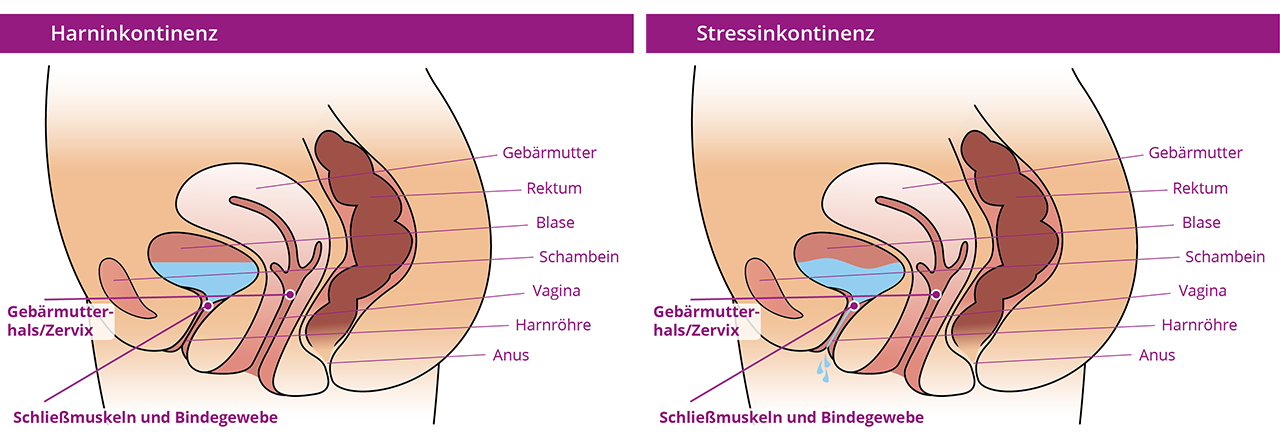
The kidneys are connected to the bladder via the ureters. Urine constantly flows into the bladder via these. A valve-like mechanism prevents the urine from flowing back into the ureters or even into the kidneys. The bladder muscles are located on the walls of the bladder. When the bladder is stretched, these normally send a message to the brain via the nerves that the bladder needs to be emptied. When urinating, the bladder muscles contract and squeeze the bladder. At the same time, the female bladder sphincter receives a signal from the brain to relax.
In women, this sphincter is located below the bladder, surrounds the urethra and is part of the pelvic floor muscles or pelvic connective tissue. The urine is held in the bladder by contraction of the sphincter. By consciously relaxing the sphincter and the pelvic floor muscles, the bladder contracts, the urethra opens and the urine can flow out of the bladder in a controlled manner.
The following factors are therefore necessary for voluntary urination:
– support of the bladder and urethra by the pelvic floor muscles and the pelvic connective tissue
– a functioning interaction between muscles, nerves and brain
Causes of stress urinary incontinence or bladder weakness
Urinary incontinence is not a disease, but a symptom that can manifest itself in different forms and have many different causes. In women, the cause of urinary incontinence is usually weakened or damaged pelvic muscles or damaged pelvic connective tissue, which prevents the urethra from closing tightly enough to hold urine in the bladder.
When does a weakened pelvic floor or stress urinary incontinence occur?
- If the supporting apparatus is overloaded, for example through heavy physical work
- In case of connective tissue weakness
- Through pregnancy and birth
- If overweight
- Even during menopause, the lack of estrogen has a detrimental effect on the strength of the pelvic floor
How does restifem work for stress urinary incontinence?
In addition to the conventional support function for the vagina and uterus, restifem offers a type of abutment in the area of the posterior vaginal vault thanks to its special shape. This abutment counteracts the pressure in the abdominal cavity and thus ensures that the support structures are relieved of pressure in a more anatomically correct way. The bladder and urethra are raised, and the pelvic floor muscles are relieved.
1. Preventative effect
Pregnancy and childbirth, whether spontaneous or by Caesarean section, lead to overstretching of the pelvic connective tissue and overloading of the pelvic floor muscles. Pessary therapy is intended to relieve both of these stresses in order to support the recovery process.
2. Therapeutic effect
For women who suffer from stress urinary incontinence, these symptoms can be improved or eliminated by wearing restifem , as it supports the fascial structures, which can lead to the restoration of urinary continence. This therapeutic effect also applies to women outside the recovery period, including during and after menopause.
A detailed description of how it works can be found in the Restifem – Instructions for use.